
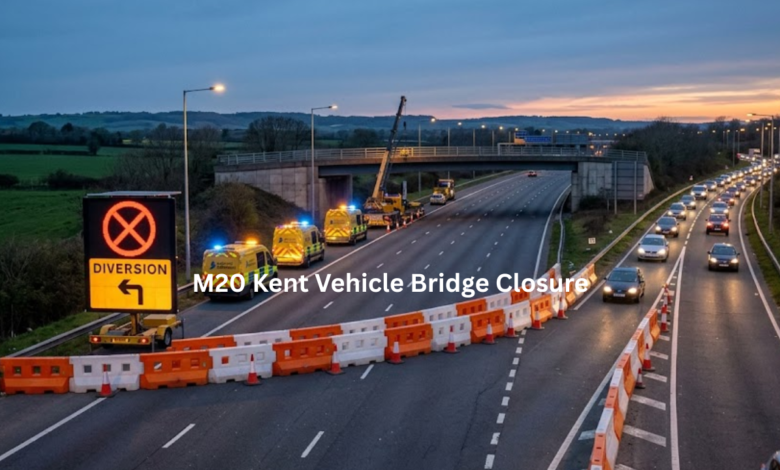
Driving through Kent can be a scenic experience, but for anyone using the M20, bridge closures and maintenance work are often part of the journey. Whether it is the planned replacement of aging structures or the deployment of traffic management systems like Operation Brock, staying informed is the only way to avoid long delays.
This guide provides a comprehensive look at the current status of M20 Kent vehicle bridge closures, the impact of recent maintenance schemes, and how you can navigate the Garden of England without getting stuck in a tailback.
The Current State of M20 Bridge Maintenance
The M20 is the backbone of Kent’s infrastructure, connecting London to the vital ports of Dover and the Eurotunnel. Because it carries a high volume of heavy goods vehicles (HGVs), the bridges spanning the motorway undergo significant stress.
National Highways has been executing a long-term strategy to repair and replace several “life-expired” bridges. These projects often require full weekend closures or overnight shuts to allow for the safe removal of old concrete decks and the installation of new steel structures.
Why Bridges Close on the M20
Most closures on the M20 are not due to emergencies but are carefully planned maintenance windows. The primary reasons include:
- Expansion Joint Replacement: These allow the bridge to flex during temperature changes.
- Parapet Repairs: Ensuring the safety barriers on top of the bridges meet modern standards.
- Structural Replacement: Some bridges, built in the 1960s and 70s, simply reach the end of their safe operational life.
Major Bridge Projects and Traffic Impact
In recent months, specific sections of the M20 have seen increased activity. For instance, works near Junction 4 (Leybourne) and Junction 6 (Maidstone) often involve bridge deck refurbishments. When these structures are being worked on, traffic is frequently diverted onto the A20, which can lead to significant congestion through local villages.
Operation Brock and Bridge Access
While not always a “structural” bridge closure, Operation Brock significantly changes how drivers access bridge crossings over the M20. When the contraflow is active between Junction 8 (Maidstone) and Junction 9 (Ashford), certain slip roads and bridge access points are restricted to manage the flow of HGVs heading to the coast.
| Feature | Details |
| Primary Diversion Route | Usually via the A20 London Road |
| Height Restrictions | Standard A20 diversion is limited to 4.7 metres |
| Typical Closure Times | 8:00 PM to 6:00 AM (Overnight) |
| Key Affected Junctions | J4 (Leybourne), J6 (Maidstone), J8-J9 (Brock) |
Scheduled Closures and Real-Time Updates
For 2026, National Highways has outlined several maintenance windows. It is important to note that these dates can change due to weather conditions. High winds, for example, can prevent cranes from lifting heavy bridge sections, leading to last-minute postponements.
How to Check for Closures
Before you set off, you should always consult the following sources:
- Traffic England: The official real-time map for motorway conditions.
- National Highways South East: Their social media feeds provide the fastest updates on emergency closures.
- Local Radio: BBC Radio Kent and Heart Kent provide regular travel bulletins that are essential during major bridge works.
Navigating the Diversions
When a vehicle bridge closure occurs on the M20, the “hollow circle” or “hollow triangle” symbols on road signs are your best friends. Following a SatNav during a major closure can often lead you into narrow country lanes that are unsuitable for larger vehicles or already choked with diverted traffic.
Safety and Compliance During Works
Roadworks are a high-risk environment for engineers. On the M20, speed limits are strictly enforced via average speed cameras during bridge maintenance.
- Stick to the Limit: Even if the road looks clear, workers may be active under the bridge structure.
- Merge in Turn: When lanes are restricted near a bridge site, use both lanes until the merge point to reduce the length of the queue.
- Check Your Height: If you are driving a tall vehicle, pay extra attention to diversion signs, as some local bridges in Kent have lower clearances than the motorway.
Frequently Asked Questions (FAQs)
1. Why is the M20 closed for bridge work so often?
The M20 is one of the busiest freight routes in Europe. The constant weight of HGVs causes more wear and tear on bridge joints and surfaces than on standard motorways. Frequent maintenance prevents catastrophic structural failures.
2. Can I still use the A20 when the M20 is closed?
Yes, the A20 is the primary diversion route. However, it is a single or dual-carriageway in most sections and quickly becomes congested. If possible, use the M2 or A2 as an alternative route across Kent.
3. What is the height limit for vehicles on the M20 diversion?
The standard diversion route via the A20 has a height restriction of 4.7 metres. Vehicles taller than this must follow specific “High Vehicle” signage provided at the scene.
4. Are bridge closures active during the day?
Most bridge maintenance is performed overnight (typically 8 PM to 6 AM) to minimize disruption. However, major bridge replacements may require full “weekend marathons” where the road is closed from Friday night until Monday morning.
5. How does Operation Brock affect bridge crossings?
When Operation Brock is in place, the M20 is split into a contraflow. This means some local bridge junctions may have restricted access, and you might not be able to join or exit the motorway at your usual spot between Junction 8 and 9.
Final Thoughts
The M20 Kent vehicle bridge closures are a necessary inconvenience to ensure the long-term safety of the UK’s road network. While they can add significant time to your journey, being proactive is the key to a stress-free trip. Always check the latest schedule from National Highways, keep an eye on the overhead gantries for live instructions, and allow extra time if you are heading toward the Channel ports.
By staying informed and following official diversion routes, you can navigate Kent’s motorway closures with confidence and reach your destination safely.
Also Read: The Ultimate Guide to Nionenad: Transforming Efficiency in the Modern Era

One Comment