
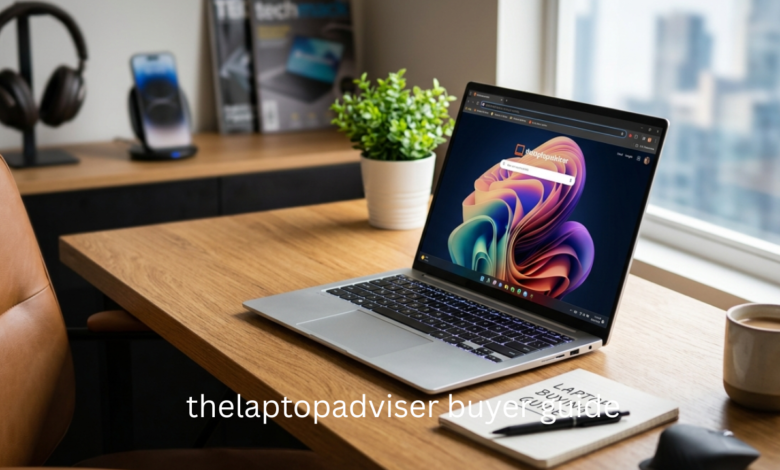
The search for a new computer can feel like navigating a digital minefield. With terms like “Neural Processing Units,” “OLED burn-in,” and “unified memory” being thrown around, it is easy to feel overwhelmed. Whether you are a student heading to university, a professional shifting to a hybrid work model, or a gamer seeking the ultimate frame rate, making the right choice is crucial.
This thelaptopadviser buyer guide is designed to cut through the marketing jargon and provide you with a clear, actionable roadmap. In 2026, the “best” laptop isn’t necessarily the most expensive one, it is the one that aligns perfectly with your specific workflow and lifestyle.
Understanding the 2026 Laptop Landscape: AI and Efficiency
The biggest shift in the industry over the last year has been the transition from raw power to “intelligent efficiency.” We are no longer just looking at how many gigahertz a processor has. Instead, we look at how well the laptop handles background AI tasks, how cool it remains under pressure, and how long the battery lasts during a full day of video calls.
In 2026, the “AI PC” is the standard. Most modern laptops now feature dedicated silicon designed to handle AI-driven tasks like eye-contact correction in meetings, noise cancellation, and even predictive text across all your apps. This means that even “budget” laptops are significantly smarter than high-end machines from just a few years ago.
Identifying Your Primary User Category
Before looking at a single spec sheet, you must identify who you are as a user. Buying a high-end gaming laptop for simple office work is a waste of money and portability. Conversely, trying to edit 4K video on an entry-level student machine will lead to endless frustration.
The Everyday User: Your world revolves around web browsing, streaming Netflix, social media, and basic document editing. You value a great screen, a lightweight design, and a battery that doesn’t die after three hours of YouTube.
The Student: You need a balance of affordability and durability. Your laptop needs to be light enough to carry across campus, have a keyboard that feels good for long essays, and a battery that survives a full day of lectures without needing an outlet.
The Professional/Creative: You are running Adobe Creative Suite, compiling code, or managing massive Excel datasets. You need high RAM capacity, a color-accurate display, and multiple ports for external monitors and peripherals.
The Gamer: Performance is your priority. You need a dedicated graphics card (GPU), a high-refresh-rate screen (at least 144Hz), and a robust cooling system to prevent thermal throttling during intense sessions.
The Processor (CPU): The Brain of the Machine
In 2026, the CPU market is more competitive than ever. The choice between Intel, AMD, and Apple (or even the rising Snapdragon X-Elite chips) depends on what software you use.
For most Windows users, an Intel Core Ultra 5 or AMD Ryzen 5 is the “sweet spot” for performance and price. If you are doing heavy video editing or 3D rendering, you should step up to the Core Ultra 7 or Ryzen 7 series.
Apple’s M4 and M5 chips continue to lead the market in power-per-watt. If you want a laptop that stays silent (fanless) and lasts 18+ hours on a single charge, the MacBook Air remains the gold standard. However, remember that Apple’s hardware is not user-upgradable; what you buy on day one is what you have for the life of the machine.
Memory (RAM): Why 16GB is the New Minimum
If there is one piece of advice in this thelaptopadviser buyer guide that you should follow strictly, it is this: Do not buy a laptop with 8GB of RAM in 2026.
Modern web browsers like Chrome and Edge, combined with AI background processes and Windows 11/12 updates, will easily consume 6GB to 7GB of RAM just by sitting idle. 16GB is now the absolute baseline for a smooth experience. If you are a professional or a gamer, 32GB is the safer bet to “future-proof” your investment for the next four to five years.
Storage (SSD): Beyond Just Gigabytes
While 512GB is the standard starting point for storage, the speed of that storage (Gen 4 vs. Gen 5 NVMe) matters more for professional work. For most people, 512GB provides enough room for applications and a decent amount of local files. However, if you plan on storing high-resolution photos or large games, aim for 1TB.
Cloud storage is great, but having fast local storage makes your laptop feel snappier when opening large apps or booting up in the morning.

Display Quality: Resolution vs. Refresh Rate
You will spend 100% of your time looking at the screen, so do not settle for a “cheap” panel. In 2026, you should look for three things:
- Panel Type: OLED has become much more affordable. It offers “true blacks” and vibrant colors that make movies and photos pop. If you can’t afford OLED, ensure you get an IPS panel with at least 300-400 nits of brightness.
- Resolution: 1080p (FHD) is fine for 13-inch screens, but if you are buying a 15-inch or larger laptop, look for 1440p (QHD) or 4K. It makes text much sharper and reduces eye strain.
- Refresh Rate: While 60Hz was the old standard, many productivity laptops now offer 90Hz or 120Hz. This makes scrolling through documents and web pages feel significantly smoother.
Ports and Connectivity: The Dongle Life
The trend toward “thin and light” has unfortunately resulted in many laptops losing their ports. When following this thelaptopadviser buyer guide, check the sides of the laptop before you buy.
At a minimum, you want:
- Two USB-C ports (preferably with Thunderbolt 4/5 support for fast charging and data).
- At least one USB-A port (for older mice or thumb drives).
- An HDMI port (if you plan to connect to a TV or monitor without an expensive adapter).
- A dedicated headphone jack (unless you are strictly using Bluetooth).
Battery Life: Marketing vs. Reality
Manufacturers often claim “24-hour battery life,” but this is usually measured with the screen at 10% brightness and all wireless features turned off. In the real world, aim for a laptop that reviewers say gets at least 10 hours of actual usage.
Apple’s Silicon MacBooks and the newer Qualcomm-based Windows laptops (Copilot+ PCs) are currently the champions of battery life. Intel and AMD have closed the gap significantly with their 2026 “Ultra” and “Ryzen AI” chips, but they still struggle to match the idle power efficiency of ARM-based processors.
Keyboard and Trackpad: The Human Interface
A laptop can have the fastest processor in the world, but if the keyboard is mushy and the trackpad is unresponsive, you will hate using it.
Look for a keyboard with at least 1.3mm to 1.5mm of “key travel.” This gives you tactile feedback that makes typing faster and more accurate. For the trackpad, “Haptic” trackpads (found on MacBooks and high-end Surface/Dell machines) are superior because they have no moving parts and allow you to click anywhere on the surface with equal force.
Graphics (GPU): Integrated vs. Dedicated
Do you need a “Video Card”?
- Integrated Graphics: Fine for 90% of people. Modern Intel Arc and AMD Radeon integrated chips can handle 1080p video editing and light gaming (like Minecraft or League of Legends) quite well.
- Dedicated GPU (NVIDIA RTX / AMD Radeon RX): Essential for 3D modeling, AAA gaming (Cyberpunk, Starfield), and professional AI development. If you are a gamer, look for an RTX 4060 or 5060 as the entry point for high-quality 1440p gaming.
Final Verdict: Buying for the Future
The best way to use this thelaptopadviser buyer guide is to look at where you want to be in three years. Software never gets “lighter”, it only gets more demanding. By spending an extra $100 today on more RAM or a better processor, you can extend the life of your laptop by two or three years, saving you money in the long run.
Always check for recent user reviews and “long-term” updates before hitting the buy button. Technical specs tell you how a laptop performs in a lab; reviews tell you how it performs on a lap.
Also Read: 08000232635: A Complete Guide to the Financial Ombudsman Service Contact Number



One Comment